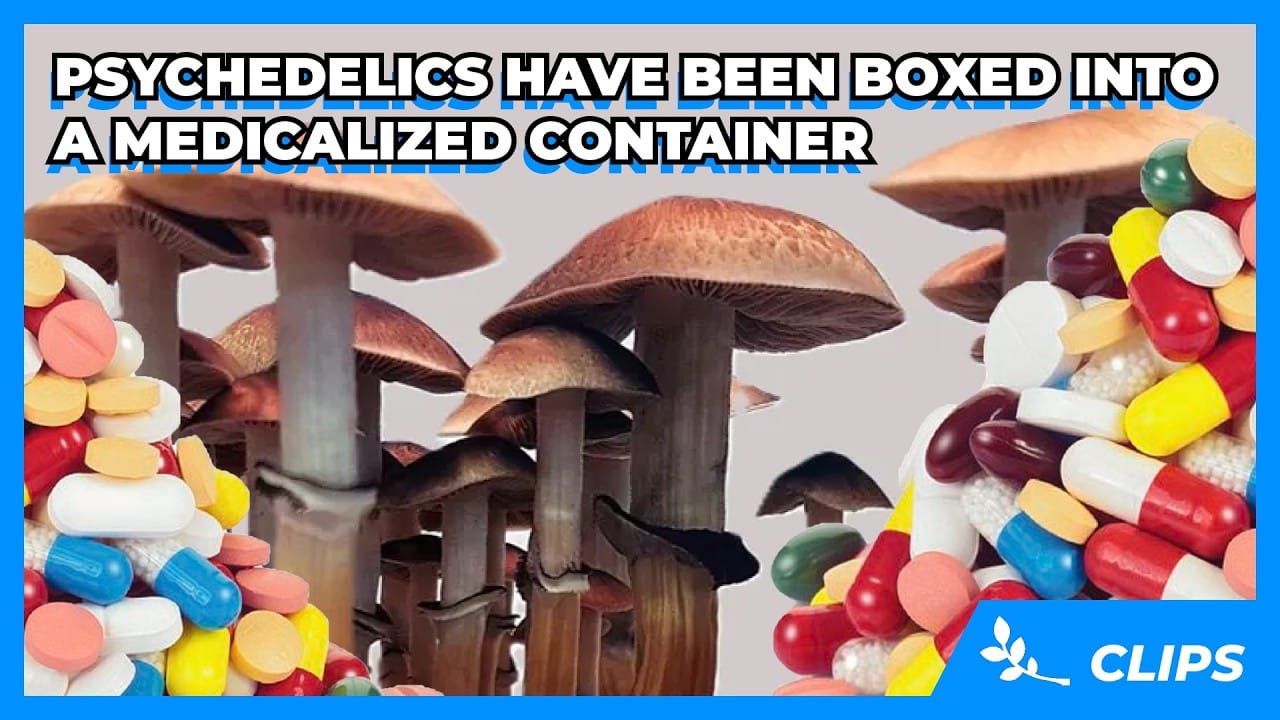
Psychedelics have been deeply boxed into a container that seems like the acceptable way that they can be talked about. I think to me the biggest shift has been in just this conversation about medicalization and the way that psychedelics have been deeply boxed into a container that seems like the acceptable way that they can be talked about. So it's—yes, I see so many more people talking about psychedelics now. I see my mother-in-law bringing it up in conversation with me, which is crazy because she was conservative, but it's very much, "this person took it because they were sick and it was a medicine and it was for healing."
There's been a push to make psychedelics acceptable by treating them as a medicine. I understand why so many people in the psychedelic community have nurtured that messaging to try to pull people like my mother-in-law into the conversation. However, I think now in the mid-2020s we've got ourselves into a really tight spot where I worry that we can't get out of this medical container. I worry that the conversation is now just becoming a bit boring to me as someone who follows it as a journalist.
The research and the conversations now are all regulatory. They're all very narrow. It's all about how to put this into a medical system and just make a new medicine. And that's fine. I think psychedelics can be useful as a medicine to lots of people, and that is a good avenue to pursue. But if it boxes off all uses of psychedelics and all ways that we can think about psychedelics—community connection, social cohesion, well-being, and other things—then we've kind of brushed all that aside and gone, "Here is a new medicine for anxiety. Here is a new medicine for depression."
Maybe 10 or 15 years ago, a lot of us in the community were cheering on these early stages of research because we were excited that things were becoming a bit legitimate after being told for so many years that these things were dangerous and had no other uses. That was an exciting moment. But now we're living in the wake of that: massive pharmaceutical companies controlling the clinical trials and very little other conversation. That's the tension I'm seeing—how limited the conversation is now about psychedelics. It opened up and many more people are talking about it, but it's narrowed into a way of talking that needs to be broken up a bit.
There has been such an impoverishment of the imagination that is going to limit the types of psychedelic experiences that people can have, without people realizing they're boxing themselves in because they just think this is what psychedelic therapy is. They don't realize that was just a limited construction.
There's also kind of an overpromise to it. Can and should the weirdness and unpredictability of psychedelics be separated from their potentially healing properties? It's hard to sell unpredictability and weirdness. The whole industry bringing this to the mainstream needs to be able to sell a promise that something's going to change and that they're going to reliably get an end result from psychedelic experiences that is predictable. I've always questioned whether that's always possible with these drugs.
They are weird and fairly unpredictable a lot of times. I think we lose something in pretending that's not true. That's why it feels strange when the biggest pharmaceutical companies buy a wild psychedelic like 5-MeO-DMT and push it forward as a depression medicine. You're taking the wildest psychedelic you can and saying, "We can put this in a clinic and give it to your grandma via a doctor's prescription when she has depression." I cannot see a world in 5–10 years where millions of people are having 5-MeO-like treatments in clinics. I don't know how you scale up something that is essentially too strange and too unpredictable to contain.
MDMA feels more predictable and might fit medically better, but when you start talking about psilocybin, LSD, and DMT, they're not nearly as predictable and we don't even have good connectivity on how they get therapeutic effects. Scaling them up to massive societal treatment programs—I'm not sure how that works.
Scientists don't fully know how these substances work. A lot of studies are functionally unblinded and their reporting is sometimes overstated. There was a study on 5-MeO claiming it's the most effective depression cure, which seems premature given the lack of robust data. The medicalization situation involves promises that may be disconnected from the evidence.
How many people do you know who became more anxious from having done psychedelics? Trials are very narrow now, pushing to regulatory endpoints. They're focused on changing points on specific depression scales, which can miss so much of what is going on in a person and the broader changes occurring. You can take a depression score, give someone LSD, ask again 24 hours later and see a change in points—but that doesn't capture the full picture.
Methodologically, some of the scales used are problematic. For example, certain clinician-interpreted depression scales are susceptible to functional unblinding, skewing results. Clinical trials for pharmaceuticals haven't changed much; they often select very narrow cohorts (someone who's "only depressed"), which is uncommon in the real world. Treatments that look effective in trials can perform differently when applied to broader, more comorbid populations. We've seen this with existing antidepressants and will likely see it again with psychedelics.
There's also sparse conversation about potential harms such as reactivations or flashbacks from substances like 5-MeO-DMT. Cynically, many developments are vehicles for attracting investment—companies can profit from hype and attention even if the products never reach market. You don't need a product to hit the market to make money off the buzz; you just need someone else holding the bag when things fail.