Russell, Mike, and Neşe sit down with journalist Rich Haridy and Dr. Samuel Douglas to discuss bush doofs, Australian psychedelic commercialization, Entheogenesis Australis, Haridy's new book, and more.
Footnotes: "Trip Reports: Stories From An Australian Psychedelic Renaissance": https://unsw.press/books/trip-reports/#buy-links "Report #3: Bryan Cranston does psychedelic therapy on Malcolm in the Middle" (Trip Reports): https://www.tripreports.com.au/malcolm-in-the-middle-cranston-psychedelic-therapy/ The Ethical Trip: https://theethicaltrip.beehiiv.com/ The Ethical Trip Etsy: https://www.etsy.com/shop/TheEthicalTrip The Psychedelic Syndicate (Psymposia): https://www.psymposia.com/psychedelic-syndicate-executive-summary-silicon-valley-maps-lykos-mdma-fda-billionaires/
Transcript
Or people are talking about ethics in psychedelic spaces — in therapy, at retreats, or whatever — but the framing is often very safe. If it's made it onto LinkedIn, the conversation is usually capitalism-compatible and medicalization-compatible. I'm starting to think it's been co-opted: people have seen an opportunity to make some money. To me, the biggest shift has been in the conversation about medicalization and the way psychedelics have been deeply boxed into a container that seems like the acceptable way they can be talked about.
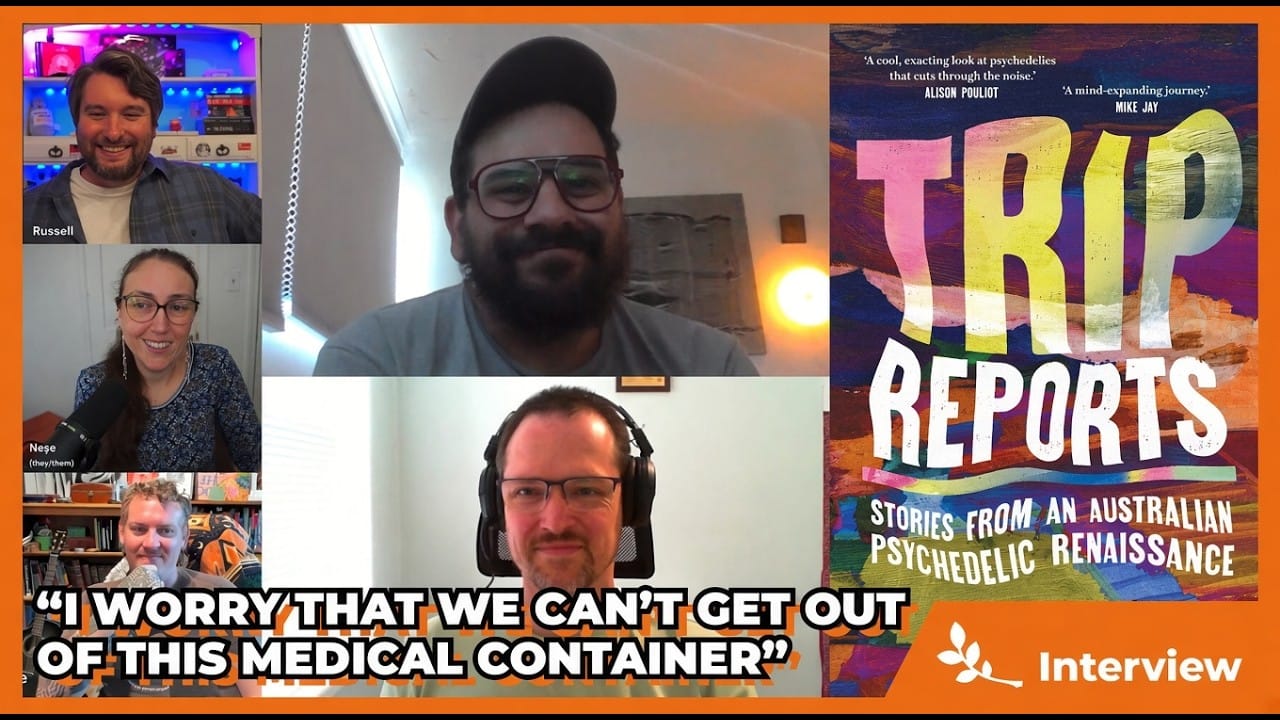
It's very much presented as: this person took it because they were sick, it was a medicine, it was for healing. There's been a push to make psychedelics acceptable by treating them as medicine. I understand why so many in the psychedelic community nurtured that messaging to bring people like my mother-in-law into the conversation. However, now in the mid-2020s, we've got ourselves into a tight spot where I'm worried we can't get out of this medical container.
That's the tension point I see nowadays: how limited the conversation has become.
Welcome to the Psymposia podcast. I'm Russell, here today with my colleagues Neşe and Mike, and we're joined by special guests from Australia: Rich Haridy and Sam Douglas. Sam is a PhD researcher involved in some psychedelic projects and ethics work across Australia. Rich is a journalist who's been covering psychedelics internationally and in Australia for the past decade and recently released the book Trip Reports.
I wanted to give each of you a chance to introduce yourselves and any history in the psychedelic landscape you'd like to put on the record. Sam, do you want to kick it off — how did you get involved in the psychedelic space and what has your history been?
When I was a child, what really got me into the space was a documentary about permaculture. That year for Christmas I demanded my parents buy me the permaculture book and I read it cover to cover. There was stuff in the back about using plants as medicines, and that started me on that path. It snowballed from there through my 20s. I got involved with the Shaman Australasia forum, which was a main forum where plant and psychedelic people congregated online in the early 2000s.
Professionally, I did a couple of degrees, including a PhD in philosophy, and most of my work had been teaching ethics at university. Psychedelics were a hobby — something I was interested in during my own time. In 2018 I got involved with the psychedelic society here, and by the time COVID rolled around I lost my university work but people wanted to pay for writing about psychedelics. I ended up as president of the psychedelic society from 2021 to 2023. That's a condensed version of my journey — none of it deliberate; it all just kind of happened. I never expected it to be public-facing, but it became that way.
I advertise "hype-free" copy on the psychedelic overground project I run. That's a unique position in the space right now — oddly, if you advertise "hype-free" copy, no one wants to buy it.
Rich, same question to you: how did you get involved and what brought you to releasing your book?
My journey was roundabout over about 25 years. I participated in the Australian bush doof scene in the early 2000s, when the psychedelic community was a real melting pot — psychonauts, bush people, scientists — all in one place. That stoked my interest, and over the last couple of decades every path I've taken has involved psychedelics in some way. I worked in film, programmed psychedelic cinema programs, and about 10 years ago started working as a science journalist. Pretty quickly my beat became the psychedelic side of science — and it turned out to be quite the time to get into science journalism on psychedelics because a lot happened over the past decade.
I still have that grounding in the community from 20–25 years ago, so it's been interesting to watch the direction things have taken. If you asked me 20–25 years ago where we'd be now, I'd have said you were crazy. We're in a weird timeline, and it's fascinating to watch it through a journalistic lens.
Because we have a largely American audience, many listeners might not know what a bush doof is. Could you provide some context about bush doofs in Australia?
I’d say bush doofs started in the early '90s. Essentially it's an outdoor party community that crossed over in the '90s with the Goa trance phenomenon. The Goa psychedelic scene influenced the Australian psychedelic community, and outdoor parties started forming that were very psychedelically infused.
Back in the day they were tucked away in state forests; you'd drive an hour or two to find someone who'd set up a sound system in the middle of nowhere. They were an adventure. They still happen, but with digital communication and increased police surveillance, the bush doof scene is different now. People still take sound systems into the bush, but they're more often caught by authorities than before, sometimes before they even start.
Is there a big difference between outdoor raves and bush doofs?
Not really; the main difference is location. An outdoor rave could be in the city. Historically in Australia, a "doof" tended to be psychedelic trance and psychedelic music, and the "rave" scene was more hard house and techno in warehouses. That distinction has blurred: now you'll find a massive diversity of music at inner-city raves and outdoor bush parties. Back in the day, there was more of a separation, but everything's mashed up these days.
Where did the Goa trance community overlap with or influence Australia?
I can't say precisely how the initial crossover happened; my entry into the world was in the early 2000s, probably a decade too late to see the beginnings. But Goa psychedelic trance in the mid-to-late '90s was definitely fuel for outdoor Australian parties. Musically, people in the early scene listened to acts like Infected Mushroom, and tastes in music helped propagate the culture.
One reason I was excited to have you both on is that we've been circling each other on social media for a long time. There's a lot of hype and over-the-top commentary about psychedelics right now. At Psymposia we try to find a balance: we appreciate psychedelics and their potential, but we also want critical perspectives. I appreciate both of you being part of that conversation.